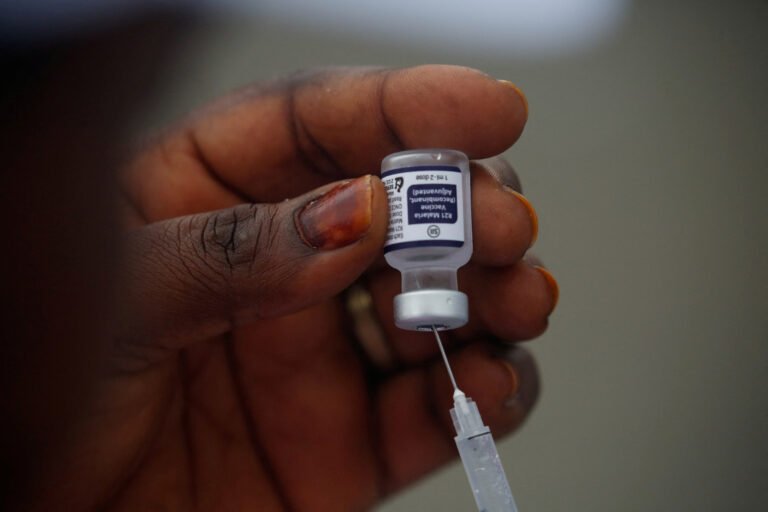
“Initially, I was interested in taking my children for vaccination, seeing how my neighbours take their children without any issues and how their children grow well. I also saw how it prevents diseases like measles. But the money that is paid to you when you go for vaccination made me lose interest….” — Excerpt from a respondent’s narrative from Northern Nigeria, taking part in the Vaccine Uptake project
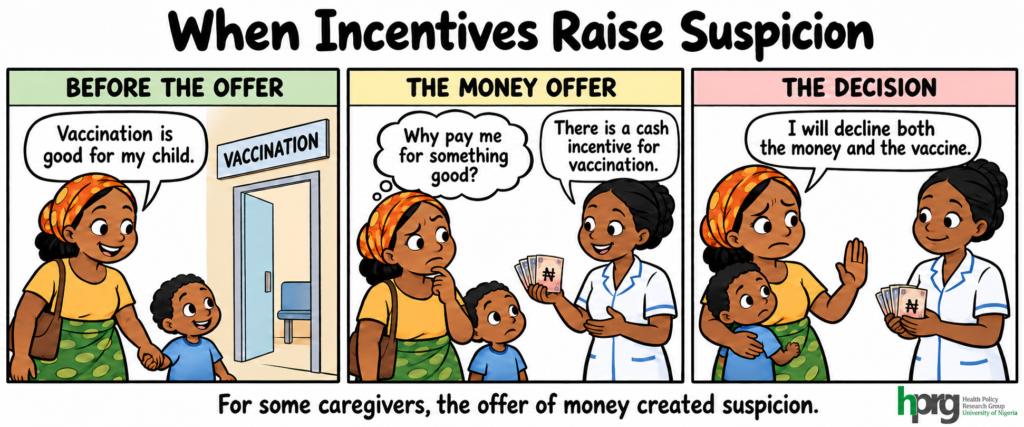
She did everything correctly and understood that vaccines help prevent diseases. However, when she visited the clinic, she noticed that some mothers were collecting money simply for bringing their children for vaccination. This was a turning point; she decided to leave with her child. For certain caregivers, financial incentives meant to promote childhood vaccination seemed to create suspicion rather than trust and motivation.
Underprivileged neighbourhoods might not trust financial incentives aimed at encouraging vaccination
As part of our project to reach zero-dose and under-immunised children in Nigeria through an integrated sectoral approach, we spoke with caregivers, healthcare workers, and community leaders across multiple communities. Our findings were mostly positive, revealing that caregivers recognise the benefits of vaccination, communities support immunisation, and social norms largely promote vaccine acceptance.
However, we also found important exceptions in which financial incentives intended to promote vaccination among caregivers in poor neighbourhoods, the very people such support was designed to help, raised suspicions toward vaccination, causing some parents to refuse to vaccinate their children. This finding was particularly striking because these caregivers were not opposed to vaccination beforehand; rather, the offer of money prompted them to question why payment was necessary for something they already believed was beneficial.
In other words, even among families facing financial hardship, suspicion outweighed immediate economic need. Given their suspicions, some caregivers chose to forgo both the incentive and the vaccine, prioritising what they believed was the safer choice for their children.
Monetary incentives could encourage uptake of vaccines, but they could create doubts
Global evidence shows that incentives work well in improving vaccine uptake, especially in economically disadvantaged neighbourhoods. Health programmes in Nigeria have demonstrated remarkable results in improving vaccination uptake through incentives. In communities where poverty, transportation expenses, and distance are primary barriers, even modest financial support can be the deciding factor.
This phenomenon has been clearly experienced in the northeast and northwest of Nigeria, where persistently low vaccination coverage improved after introducing conditional cash incentives for caregivers who completed their children’s routine immunisation schedule.
So why did monetary incentives discourage some mothers from vaccinating their children in our research?
The answer lies in a phenomenon behavioural scientists call “motivational crowding out.” When people already want to do something because they believe it is right, offering them money for it can weaken rather than strengthen that desire. Many caregivers see vaccinating their children as part of being a good parent and a responsible community member. In some cases, especially when facilities are accessible, financial incentives can shift perceptions and raise suspicions. What was a duty of care starts to look like a transaction, prompting people to ask why payment is necessary.
This reaction may be even stronger in contexts where trust in public institutions is fragile. In some Nigerian communities, distrust in government and public institutions, concerns about vaccine safety, and misinformation, including conspiracy narratives that portrayed vaccines as tools for hidden agendas or population control have influenced perceptions of vaccination in the past. These concerns were amplified during the COVID-19 pandemic, and may still shape how some people interpret vaccination programmes.
Against this backdrop, offering money can unintentionally reinforce suspicion. Some caregivers may ask, “If this vaccine is truly good for my child, why do they need to pay me to accept it?” Others may wonder why resources are available to pay for vaccination when many other pressing needs, such as food and livelihoods, remain unmet.
Our study isn’t alone
A 2025 experimental study found that among 513 vaccine-hesitant adults, about one in seven who were initially willing to be vaccinated became less willing when payment was introduced. The researchers explained this as a “signalling effect.” Rather than reassuring people, the money offer unintentionally suggested that something about the vaccine required compensation. This closely reflects what we observed in our study. The caregivers were not initially opposed to childhood immunisation. They believed vaccines were beneficial and intended to vaccinate their children. However, introducing a financial incentive raised doubts and ultimately discouraged them from vaccinating their children.
What this means for immunisation programmes
Our findings are not an argument against using financial incentives. The evidence for their effectiveness remains compelling. Rather, our findings highlight the need to design incentive programmes thoughtfully and tailor them to the social context in which they are implemented.
Importantly, these findings also remind us to respect the agency of people living in poor communities. Financial hardship does not prevent people from questioning health interventions or making careful decisions about their children’s wellbeing. Caregivers interpret programmes through the lens of their lived experiences, previous interactions and levels of trust in health systems and government institutions. They also consider prevailing community narratives and the information available to them. Their hesitation should therefore not be dismissed as ignorance alone but understood as active decision-making in contexts where trust is often fragile.
Based on our findings and the emerging evidence, immunisation programmes may wish to consider the following:
Be explicit about why and when financial support is offered. How incentives are framed matters. Explaining that a payment is intended to offset transport costs or compensate for time spent accessing vaccination services differs greatly from offering an unexplained cash payment at the point of vaccination. Clear communication helps preserve vaccination as an act of responsible parenting rather than allowing it to be interpreted as something requiring compensation. Additionally, when financial incentives are given could have different meanings — Should they be given at the completion of vaccination, rather than beforehand?
Engage communities early to understand how incentives might be perceived. The variation we observed between caregivers who were encouraged by incentives and those who were deterred suggests differences in prior motivation, social norms, and trust. These cannot be assumed, they must be learned. Creating opportunities for community co-creation can help identify potential concerns and ensure that programmes are responsive to local contexts. The WHO BeSD framework offers a structured way to support this process before programme design is finalised.
Beyond vaccination coverage, monitor how incentives are being interpreted. Measuring uptake alone may not tell the whole story. A programme may improve overall immunisation based on data while unintentionally discouraging a small group of caregivers already motivated to bring their children for vaccination. Collecting qualitative feedback from caregivers and communities can help identify concerns early, allowing programmes to adapt their communication or incentive strategies before mistrust becomes entrenched. In contexts where distrust in government or public institutions is particularly high, programmes may also need to consider alternative approaches to reducing financial barriers, such as transport vouchers, reimbursement of direct costs, or community-led support mechanisms, rather than relying solely on direct cash incentives.
Conclusion
Overall, the evidence is clear that financial incentives, when well-designed and clearly communicated, are among the most cost-effective tools for reaching under-immunised children, particularly in low-income settings where poverty is the primary barrier. However, Nigeria has some nuanced experiences with conditional cash transfers for vaccination, which should be treated with caution. It is not only about what is provided, but also how the gesture is interpreted and the surrounding context.
Authors’ Bios
Dr. Uzoma Diarah is a Medical Officer at the Enugu State Government House Medical Centre and Health Marketing & Communications Manager at Studypages PBC, San Francisco. She is a researcher at the Health Policy Research Group, University of Nigeria, with research interests in vaccine uptake, sexual and reproductive health, and health policy and systems research.
Prof. Chinyere Mbachu is the Principal Investigator of the vaccine uptake research project and a Professor of Community Health in the Department of Community Medicine, College of Medicine, University of Nigeria, Enugu Campus. A Fellow of the West African College of Physicians (FWACP) in Community Health, she has spent much of her career building the field of health policy and systems research in Nigeria, including training policymakers, practitioners, and postgraduate medical doctors in the use of evidence for policy and practice. Her research interests include health systems governance and accountability, political economy analysis of health reforms, and getting research evidence into policy and practice.
Acknowledgement
This work was conducted as part of the Reaching Zero-Dose and Under-Immunised Children in Nigeria project, one of six country projects under the Alliance for Health Policy and Systems Research’s multicountry programme, Health Policy and Systems Research for Improving Vaccine Uptake in Low- and Middle-Income Countries. Also, we thank Dr Prince Agwu for providing his expertise as a critical friend during the review.